
November 2025 Nickel & Surcharge Update

Monthly Nickel and Surcharge Update
November 2025 Update
Thanks for reading the Ram Alloys Monthly Nickel and 316L s/c update, intended to help our valued customers make educated business decisions.
THE FOUR (4) TRUMP TARIFFS
- One - Drug War:
-
- Validity subject to upcoming Supreme Court Ruling
- Originally: 25% Tariff on Canadian and Mexican Imports | 20% Tariff on Chinese Imports
- Began March 4th
- Not excluded from Trade War Reciprocal Tariffs
- August 1, 2025: Canadian tariffs increased to 35%
- August 1, 2025: Mexican negotiations extended 90 days
- Two - Steel War: INCREASED TO 50% Section 232 Tariff on all COPPER, Steel and Aluminum
-
- Validity NOT subject to upcoming Supreme Court Ruling
- Began March 12th - Original Tariff = 25%
- Quotas Eliminated. Exemption Process Terminated
- Excluded and separate from Trade War Reciprocal Tariffs
- June 4th: Tariff Rate Raised to 50%
- Except for UK - remains 25% while they negotiate (still negotiating)
- Tariffs for "derivatives" of steel and aluminum remain difficult to analyze, as either reciprocal or Section 232 tariffs apply, but the method for applying either is unclear
- August 1, 2025: Copper added to the 50% Section 232 tariffs, along with steel and aluminum
- Three - Trade War: Reciprocal Tariffs
-
- Validity subject to upcoming Supreme Court Ruling
- April 2, 2025: Reciprocal Tariffs Announced
- Since April 2nd it's been chaos and confusion - the White House has issued statements, agreements, corrected statements, revised agreements, and so on
- On July 31st, the day before the extended deadline, President Trump signed an Executive Order adjusting the so-called “reciprocal” tariff rates announced on April, 2, 2025.
- The adjusted tariff rates, ranging from 10-41 percent, will take effect on August 7, 2025. Goods loaded onto a vessel at the port of loading and in transit on the final mode of transit before August 7, 2025 and entered before October 5, 2025 are exempt from the adjusted rates. Countries not listed in the table below are subject to a 10 percent reciprocal rate.
- EU, Japan, South Korea, and some others have announced a trade frameworks, but no deal finalized and some are in limbo
- Four - BRICS Tariff (new - threatened)
-
- July 7, 2025: President Trump threatened a new tariff "an additional 10% tariff on countries that orient themselves along the 'Anti-American policies of BRICS."
- Meaning, application, interpretation, impact, etc.
- BRICS of course stands for: Brazil, Russia, India, China, and South Africa
- Other members include Saudi Arabia, Egypt, Iran, Ethiopia, the United Arab Emirates, and Indonesia
- BRICS Partner Countries: Belarus, Bolivia, Cuba, Kazakhstan, Malaysia, Nigeria, Thailand, Uganda, Uzbekistan, and Vietnam
- Since July 7th, Brazil has been hit with higher tariffs (no 40%) and India has been threatened with an additional 100% tariff due to their Russian energy purchases
- The "Sanctioning Russia Act" currently before the Senate contemplates up to 500% tariffs
Drug War and Reciprocal Tariff SCOTUS Trial
On August 29th, the Court of Appeals for the Federal Circuit ruled President Trump exceeded his authority and invalidated several tariffs. Notably, Section 232 Tariffs on Steel, Aluminum, and Copper remain unaffected and valid.
SCOTUS expedited the appeal and heard over 2.5 hours of oral arguments on November 5th.
The law at the center of the case is the International Emergency Economic Powers Act (IEEPA). Enacted in 1977, the president can invoke it “to deal with any unusual and extraordinary threat, which has its source in whole or substantial part outside the United States, to the national security, foreign policy, or economy of the United States,” if he declares a national emergency “with respect to such threat.” Under Section 1702 of the law, when there is a national emergency, the president may “regulate … importation or exportation” of “property in which any foreign country or a national thereof has any interest.”
Reports from the hearing indicate a majority of the Court substantially questioned the President's power to levy the Reciprocal Tariffs, as it views them essentially a Tax and only Congress as the power to tax citizens. However, as we previously noted, some Justices recognized the "mess" created by unwinding the tariffs and also the fact that President Trump could simply deploy a new round of legally permissible tariffs for the same result, just different names.
The Court usually issues opinions in the summer following oral arguments (June/July), but many believe it will expedite this ruling. Recently, President Trump announced a possible "$2000 Tariff rebate." Why is this significant? In our opinion, because if the President loses, he could argue he's already paid the damages to the ones "taxed," so no harm, no foul. The chain of custody for those harmed by tariffs is too complicated (think about it - the supplier reimburses the manufacturer, who pays the fabricator, who pays the industrial application, who pays storefront, who pays the consumer - impossible). Accordingly, we believe a direct payment from the USA government to the consumer is really the only method of compensation, which would effectively negate any impact of an unfavorable ruling. This is especially true if the Court finds the tariffs are actually a tax - rebate refunded.
So while this is an interesting case, and there could be important Constitutional implications, the decision will likely "split the baby" (Trump overreached, but damages already paid, and Trump can issue tariffs under XYZ laws), so the tariff world will continue...until:
- The consumers revolt after losing Italian pasta (see article below); OR
- We actually sign and transact under all the new, beautiful trade deals that attempt to neutralize previously unbalanced relationships.
The latter scenario is clearly preferred and a positive result for all.
Current Take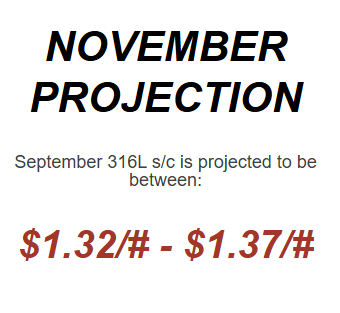
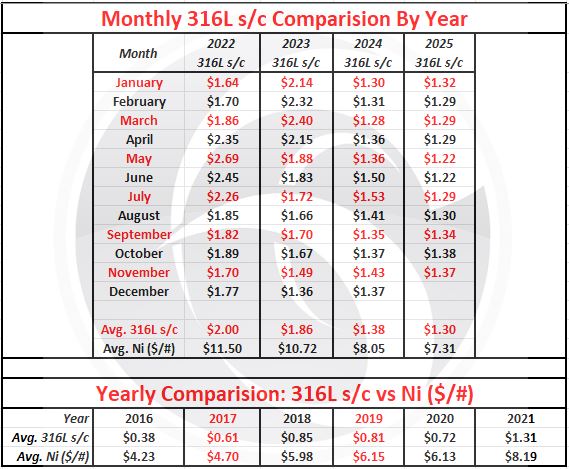
RAW MATERIAL PRICES: November 316L surcharges decreased by $0.01/# due to a drop in iron prices. This appears market based, as demand has tempered. Boeing's recent FAA approvals will impact demand late next year (which may coincide with an oil and gas uptick).
LEAD TIMES: Domestic steel capacity is insufficient to fulfill US demand in any market. Lead times are, as expected, mixed:
- USA mills lead times are pushing out
- Foreign mills are hungry and aggressively pursuing business
BASE PRICES: Recent USA price increases remain in effect, and we expect them to hold given extended lead times.
SECTION 232: JUNE 4TH - 50% TARIFF applied to all imported copper, steel, and aluminum. Quotas and exemptions were eliminated. Reciprocal tariffs do not apply to good accessed Section 232 Tariffs.
As distributors work through old inventory, be aware of potential pricing shock due to 50% tariffs.
| RAM'S REACTION: Filter the noise. Control what we can control. Attempt to define as many variables as possible in a world surrounded by unknowns. Leverage our inventory, operational excellence, and market knowledge to assist our customers in times of crisis. In other words...business as usual. |
Yearly/Monthly 316L s/c and Ni Charts
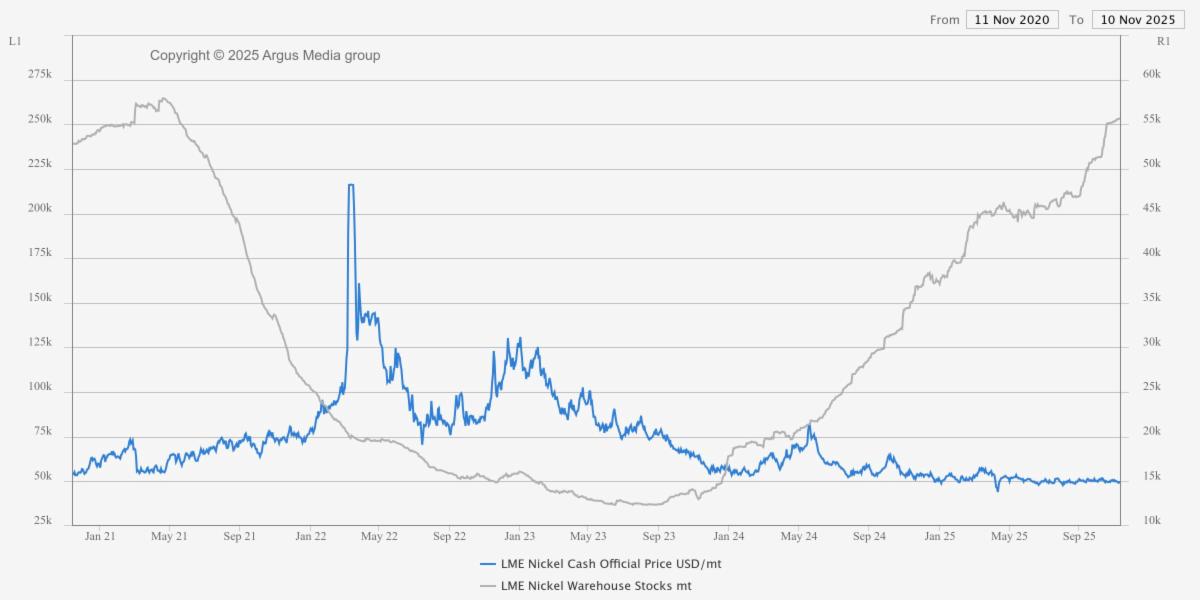
US DOLLAR (DOWN) v. LME (Ni) Price (UP)
Copyright (c) 2024 Argus Media Group
Industry News
|